SurgBioMech / Pocivavsek Lab
Established2020
AffiliationsUChicago Surgery · Biophysical Sciences
Principal InvestigatorLuka Pocivavsek, MD PhD

A study of Geometry & the biomechanics of surgical anatomies & biological interfaces.

“Surgery is anatomy.
Anatomy is geometry.
Geometry is the heart of mechanics.” — the lab’s working axiom

We work at the boundary between physical science and surgical medicine. The lab studies how shape—at every scale from a lipid film to the aortic wall—controls how tissues fail, how implants seal, and how surfaces remain clean. We translate this into tools that read the geometry of a single patient and predict what their disease will do next.

Read on
§ 01

The Principal Investigator

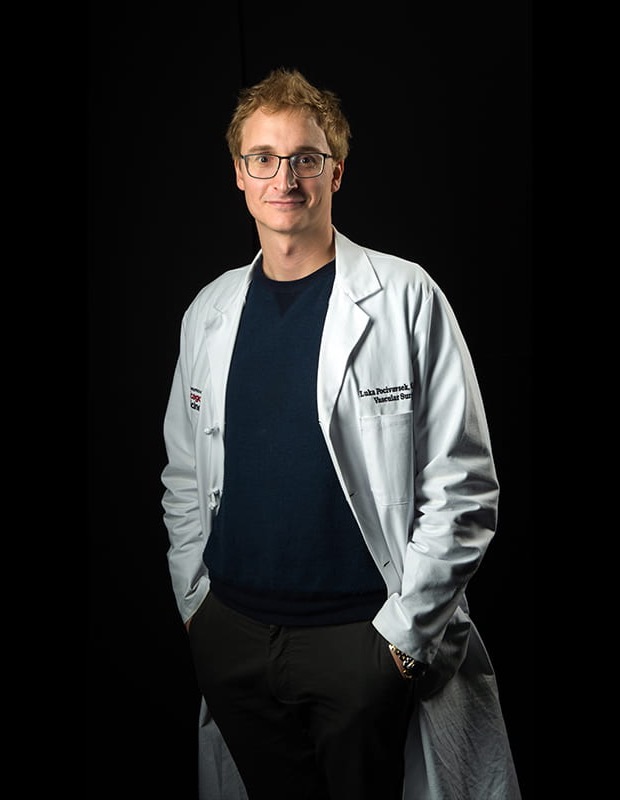
Portrait of Luka Pocivavsek, MD PhD
Pl. I Luka Pocivavsek, MD PhD — University of Chicago.

Luka Pocivavsek, MD PhD

Associate Professor of Surgery · Vascular Surgeon · Physicist

Luka Pocivavsek trained as a physicist and a surgeon at the same institution in which the lab now sits. His doctoral work—published in Science and Soft Matter—established a quantitative theory for how thin elastic membranes wrinkle and fold under compression. The translational consequence of that theory is the line of thought our lab still follows: shape is a diagnostic. The curvature of an aortic arch, the seal of an endograft, the topography of a vascular surface—each carries a mechanical signature that predates the clinical event by years.

Clinically, Dr. Pocivavsek is an open and endovascular vascular surgeon at the University of Chicago Medicine. His practice spans complex aortic reconstruction, cerebrovascular disease, and peripheral vascular surgery. He is a member of the Committee on Medical Physics and the Pritzker School of Molecular Engineering.

Training
  • 2001 B.S., Duke University
  • 2005 M.S., University of Chicago
  • 2009 Ph.D., University of Chicago
  • 2011 M.D., University of Chicago (MSTP)
  • 2011–18 Surgery Residency, UPMC
  • 2014–16 Postdoctoral Fellow, UPMC
  • 2018–20 Vascular Fellowship, U. Chicago
Bibliometrics
  • 1,637Citations
  • 17h-index
  • 25i10-index
Honors
  • Provost's Global Faculty Award (2020)
  • UPMC Innovation Research Awardee (2017)
  • Innovation Institute First Gear Fellow (2016)
  • NIH MSTP Scholar (2003–11)
§ 02

Lines of Inquiry

Six interlocking threads, all variations on a single theme: how does geometry encode mechanical risk in a living tissue?

01 soft matter · elasticity

Wrinkling, folding & localization

Thin elastic films on liquid substrates do not buckle uniformly—they localize their stress into folds. Our 2008 Science paper established a generic wavelength selection law for this transition, and the work has since become a reference point for soft-matter mechanics of lipid monolayers, polymer sheets, and biological membranes.

02 aortic disease · morphoelastic growth

Aortic dissection & aneurysm geometry

Working with longitudinal CT cohorts we develop curvature- and torsion-based descriptors that map how aortic dissections evolve and how abdominal aortic aneurysms grow. Recent work uses sparse identification of nonlinear dynamics (Z‑SINDy) to extract patient-specific growth laws from imaging.

03 endograft mechanics · seal failure

Endovascular repair & seal-zone stability

A stent graft is a deformable cylinder mounted inside a curved, pulsatile vessel. We characterize the geometric and material conditions under which a proximal seal will hold versus migrate, with a long-term goal of patient-specific landing-zone selection prior to EVAR/TEVAR.

04 topography · self-cleaning · grafts

Topography-driven surface renewal

Surfaces that wrinkle dynamically can shed adherent fouling. Published in Nature Physics and Biomaterials, this thread uses active wrinkling as a strategy for keeping vascular and prosthetic surfaces clean without chemical coatings.

05 hemodynamics · CFD

AV fistula & congenital hemodynamics

Computational fluid dynamics of arteriovenous fistulae and complex congenital pathways. We study how wall shear distribution drives neointimal hyperplasia and how surgical geometry can be reshaped to extend patency.

06 computational geometry · imaging

Differential geometry on patient meshes

We build open-source tooling for principal-curvature, second-fundamental-form, and torsion estimation on noisy 3D surfaces from clinical CT. Our codebases (anato-shape and anato-poly-smooth-curve) are used by the lab and by external collaborators.

§ 03

Selected Publications

A complete and current list lives on Google Scholar. The work below shaped how the lab thinks today.

  1. 646citations

    Stress and fold localization in thin elastic membranes

    L. Pocivavsek, R. Dellsy, A. Kern, S. Johnson, B. Lin, K. Y. C. Lee, E. Cerda · Science 320, 912–916 · 2008 · doi:10.1126/science.1154069

  2. 103citations

    Geometric stability and elastic response of a supported nanoparticle film

    B. D. Leahy, L. Pocivavsek, M. Meron, K. L. Lam, et al. · Physical Review Letters 105, 058301 · 2010 · doi:10.1103/PhysRevLett.105.058301

  3. 86citations

    Lateral stress relaxation and collapse in lipid monolayers

    L. Pocivavsek, S. L. Frey, K. Krishan, et al. · Soft Matter 4, 2019–2029 · 2008 · doi:10.1039/b804611e

  4. 82citations

    Topography-driven surface renewal

    L. Pocivavsek, S.-H. Ye, J. Pugar, E. Tzeng, E. Cerda, S. Velankar, W. R. Wagner · Nature Physics 14, 948–953 · 2018 · doi:10.1038/s41567-018-0193-x

  5. 53citations

    Active wrinkles to drive self-cleaning: a strategy for anti-thrombotic surfaces for vascular grafts

    L. Pocivavsek, S.-H. Ye, J. Pugar, E. Tzeng, E. Cerda, S. Velankar, W. R. Wagner · Biomaterials 192, 226–234 · 2019 · doi:10.1016/j.biomaterials.2018.11.005

  6. 54citations

    Glycerol-induced membrane stiffening: the role of viscous fluid adlayers

    L. Pocivavsek, K. Gavrilov, K. D. Cao, E. Y. Chi, D. Li, et al. · Biophysical Journal 101, 118–127 · 2011 · doi:10.1016/j.bpj.2011.05.036

  7. 32citations

    Geometric tools for complex interfaces: from lung surfactant to the mussel byssus

    L. Pocivavsek, B. Leahy, N. Holten-Andersen, B. Lin, K. Y. C. Lee, E. Cerda · Soft Matter 5, 1963–1968 · 2009 · doi:10.1039/b817513f

  8. 13citations

    The geometric evolution of aortic dissections: predicting surgical success using fluctuations in integrated Gaussian curvature

    K. Khabaz, K. Yuan, J. Pugar, D. Jiang, S. Sankary, S. Dhara, J. Kim, … R. Milner, L. Pocivavsek · PLOS Computational Biology 20(2), e1011815 · 2024 · doi:10.1371/journal.pcbi.1011815

  9. 2025recent

    Bare metal stenting for residual arch dissections: a computational analysis

    Ž. Donik, S. Dhara, W. Li, B. Nnate, S. Sankary, K. Polcari, M. A. Varsanik, K. Khabaz, R. Milner, N. Nguyen, J. Kramberger, L. Pocivavsek · Cardiovascular Engineering and Technology · 2025 · doi:10.1007/s13239-025-00799-6

§ 04

Open Code & Data

We release tooling on the lab's GitHub organization. Pull requests welcome.

Jupyter

anato-shape

Curvature calculations on 3D surface meshes of complex anatomies. Notebooks and helper functions for principal curvatures, mean and Gaussian curvature, normal estimation.

Python

anato-poly-smooth-curve

Polynomial smoothing and curvature estimation of noisy biological surfaces, with application to aortic morphology. Companion code for the methods paper.

Python

aaa-dynamics

Analysis code for "Dynamic Temporal Modeling of Abdominal Aortic Aneurysm Morphology with Z-SINDy." Sparse identification of nonlinear growth dynamics from CT.

Python

plos_data

Research data & analysis for the 2024 PLOS Computational Biology publication on aortic dissection geometry and surgical outcome prediction.

§ 05

Methods in the House

i

Computational geometry

Curvature, torsion, geodesics on patient-specific meshes.

ii

Finite-element analysis

Hyperelastic vessel-wall models and endograft contact mechanics.

iii

Computational fluid dynamics

Pulsatile flow in arch, fistula, and congenital geometries.

iv

Micro-CT & X-ray scattering

Resolved structure from tissue to monolayer.

v

Langmuir monolayers

Compression isotherms and fold nucleation in lipid films.

vi

Machine learning

Graph neural networks for growth mapping; sparse system identification.

§ 06

People

Principal Investigator
Luka Pocivavsek, MD PhD
Associate Professor of Surgery · Vascular Surgery · University of Chicago
Lab Members · current roster

Research Faculty & Staff

  • Nhung Nguyen, PhDAsst. Research Professor
  • Kathleen Cao, PhDResearch Scientist

Postdoctoral Scholars

  • Joseph A. Pugar, PhD
  • Sanjeev Dhara, MD
  • Anna Gaffney, PhD

Graduate Students

  • Michael MansourMD–PhD · Medical Physics
  • Kameel KhabazMD

Undergraduate Students

  • Charlie DavisNeuroscience
  • Mohan JauharNeuroscience
  • Duc NguyenPhysics & Math
  • Nehemiah JamesMolecular Engineering
  • Deqa MuseChemistry · HIPS
  • Matheus Martino-WojciechowskiNeuroscience · History

Visiting Students

  • Niels BlankensteijnMed. Student · Erasmus MC
  • Mason McIntyreUndergrad · Emory
  • Shreya SinghUndergrad · Loyola Chicago
  • Vijnna AppasaniIMSA
  • Jonah AustenUChicago Lab Schools
  • Noor MaloHinsdale South HS
  • Josue Garcia-AlvaradoWalter Payton Prep

Inquiries about postdoctoral, graduate, and undergraduate positions are welcome.

§ 07

Contact & Address

Correspondence
lukap@uchicago.edu
lpocivavsek@bsd.uchicago.edu
Mailing address
SurgBioMech · Pocivavsek Lab
Department of Surgery
University of Chicago
5841 S. Maryland Avenue
Chicago, IL 60637